RSS

Category Archives: Musings

On the trail, in the wool

Trailing toward the lambing grounds

Trailing toward the lambing grounds

Ideally, this time of year, we are done shearing and are on the trail to the lambing grounds, north of Dixon. It is critical that the ewes be sheared before lambing starts, yet this is proving increasingly difficult. It has a lot to do with the really dysfunctional H2A program in the Department of Labor, which facilitates the non-immigrant program for foreign agricultural workers. For us, this includes our valued and essential Peruvian sheepherders. For the shearing contractors, it allows them to hire highly skilled and highly paid sheep shearers, mostly from New Zealand, and sometimes Australia and other countries. The program has become so unwieldy that many shearing contractors have given up, and the remaining shearing crews are having difficulty in getting the wool off the ewes in a timely manner. This has resulted in a backup throughout the sheep herds in the Rocky Mountain West, and most producers, like us, are facing shearing during lambing–a process which is difficult for shearers, sheep producers, and is very hard on the heavily pregnant or recently lambed ewes. Nonetheless, here we are trailing ewes, still in the wool, to the lambing grounds, where we pray our shearing crew will show up very soon, and we pray that we will not have a loss of lambs to pay for the incoherent federal immigration politics.


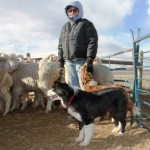
Guard dog on the trail

Guard dog on the trail

 
Leave a comment

Posted by on May 3, 2015 in Animals, Dogs, Musings, Sheep


Tags: , , ,

Solving the problems of the world at the National Cowboy Poetry Gathering

Horseman Torran Duncan with Dad, saddlemaker and rancher Keith Duncan.

Horseman Torran Duncan with Dad, saddlemaker and rancher Keith Duncan.

As I said, we were WORKING!  Pat, our son-in-law  and meat purveyor Chris Abel and I were on the panel that discussed “Food Production and the West.” We were joined by California “urban farmer” A.G. Kawamura, and Family Farm Alliance Executive Director Dan Keppen. Since our roundtable was scheduled at the same time as Baxter Black’s show, we were wondering if anyone would show up. We visited with Dr. Black in the Green Room before the show, and I told him I hoped we didn’t draw away from his sold-our, lottery only show. Luckily, a goodly number of dedicated issue junkies showed up (or maybe those who didn’t draw a Baxter Black ticket–but, hey, a girl can dream!).

Pat, fellow Carbon County resident and wonderful singer Trinity Seeley, and baxter Black, probably discussing food policy

Pat, fellow Carbon County resident and wonderful singer Trinity Seeley, and Baxter Black, probably discussing food policy

Chris, Dan,Pat, Sharon, and AG discussing how to feed 9+billion people in a few years

Chris, Dan,Pat, Sharon, and AG discussing how to feed 9+billion people in a few years

Keynote speaker Temple Grandin with Chris Abel.

Keynote speaker Temple Grandin with Chris Abel.

 
Leave a comment

Posted by on February 1, 2014 in Events, Family, Folks, Issues, Musings


Tags: , , , , , , , ,

Wearing out the winter

Pat and McCoy with the heifers

Pat and McCoy with the heifers

This is the time of year when we hold our breath. We hope all the cows and sheep and various critters for whom we are responsible have enough to eat, enough to drink and enough body fat to withstand the cold weather. We assume that the bulls and bucks have done their jobs. We hope that the Good Lord sticks with us with weather and sends enough snow, but not too much; enough cold, but not too much. We hope that the cows and the ewes are all pregnant, and will hold those pregnancies to term, and raise a baby. We hope that predators–mostly coyotes, but bears, mountain lions, ravens, crows and maybe wolves–will find something else to eat besides our critters. The sheep eat snow and we depend on having the right amount–not so much that it will cover the grass and brush, but not so little that we are chasing drifts in draws. The cows need “wet water” and we expend a lot of energy and resources to make sure it’s available.

It is also the time of year that we try to ensure that we have enough help lined up for spring, summer and fall. Our sheepherders come on h2a visas which allow them to stay for three years with at least three months at home in Peru. We try to plan so that about one third of our crew returns to Peru in the winter, when we need less help. The process is so dysfunctional that we need to request about twice as many “new guys” as we will probably need, because there isn’t much rhyme or reason to who gets approved. Even returning employees are not assured of getting approved, so it is a challenge to plan.

So far, the winter has been cooperative. This will allow us to engage in one of our favorite vacations: traveling to Elko, Nevada–at approximately the same latitude as our home (read Deep Winter) for the National Cowboy Poetry Gathering. We will be hosting a  discussion on Food Policy. After all, to have cowboys, we need cows, and to have cows, we need consumers: the Three C’s. That said, it is nearly a week of solid poetry, music, art and discussion which is nothing but fun.

Sheep near Eagles' Nest. The bucks are in their working clothes.

Sheep near Eagles’ Nest. The bucks are in their working clothes.

Antelope at Powder Flat

Antelope at Powder Flat

McCoy and Nene

McCoy and Nene

McCoy, Eamon and Pat on the lookout at Lower Powder Springs

McCoy, Eamon and Pat on the lookout at Lower Powder Springs

Pat, McCoy and Eamon at water well at Powder Flat. I used to spend hours here pumping water with our old generator, "Fred".

Pat, McCoy and Eamon at water well at Powder Flat. I used to spend hours here pumping water with our old generator, “Fred”.

Punk colts

Punk colts

Tim, McCoy, Eamon, Pat, Oscar

Tim, McCoy, Eamon, Pat, Oscar


Tags: , , , , , , , , ,

Corn and sheep getting ready for romance

plenty of snow

plenty of snow

The bucks will join the ewes on December 15th so that they will start lambing on May 10th. We want both the ewes and rams to be fat and happy for this occasion. We need snow (but not too much snow) because the sheep depend on it for winter water. They can survive by eating snow, and there’s not much live water on the Red Desert, especially during the frozen winter months. We also depend on feeding corn during the bucking season, which will last until the beginning of February–two heat cycles for the ewes. The government-mandated corn ethanol program has been devastating to the livestock sector, as it drove prices to new highs in 2013. Corn prices are down some, due to a bumper crop. In any case, there is no substitute for corn as a nutrition-packed supplement to support the ewes as they survive often harsh conditions, conceive lambs, and grow next year’s wool crop. It is amazing that they can convert desert grass to food and fiber for people!

I80 behind, winter pasture ahead

I80 behind, winter pasture ahead

Guard dog on the move

Guard dog on the move

Where ARE those bucks?

Where ARE those bucks?

Al the trucker opens the pot

Al the trucker opens the pot

Corn ready to bag and feed

Corn ready to bag and feed

Tri-State delivers!

Tri-State delivers!


Tags: , , , ,

Wendell Berry’s 17 Rules For A Sustainable Economy

Here’s a link to some words of wisdom from that wise old farmer.

Wendell Berry’s 17 Rules For A Sustainable Economy – Mendo Island Transition.

 
1 Comment

Posted by on December 2, 2012 in Folks, Musings


Fall: Come and gone

Fall:  Come and gone

This has been a weird weather year..  We had a hard cold winter, followed by a cold wet killer spring.  The summer was brief and rainy.  We started haying three weeks late, but then had an Indian Summer which allowed us to finish the haying–three weeks later than usual.  In the midst of all this, we have been moving.

When my Dad died last Christmas, we decided to do a few minor upgrades to his house.  That house is the home that my grandparents built in 1916 or so.  The “Big House” and the horse barn were built by a couple of Swedish brothers. who built several of the beautiful old ranch homes in our valley.  We also decided to shore up the crumbling foundation of the historic horse barn, and of the even older cow barn, which was on the headquarters when my grandfather, George Salisbury and his bride Emma, bought it from Oscar Beeler in the early 1900’s.

Our plan was for us to finish the remodeling and move into the big house in early summer, and for our daughter Meghan, her husband Brian, and their four kids to move into our house, across the driveway, affording them more room.  We are not done yet.  Our minor remodel has turned into gutting most of the interior walls and replacing the heating, plumbing and electrical systems, as well as the insulation.  We installed drains so the basement wouldn’t flood annually, or when we left the lawn sprinklers too close to the house.  In the meantime, the nicely finished downstairs at our old house flooded up to the flooring.  We could not figure out why since it hadn’t happened in previous wet springs.  In early October, it was still flooding, so we bit the bullet, dug out the foundation and replaced the French drains.  After much backhoeing, we discovered that a NEW spring had sprung just uphill from the house.  I pointed out that the homesteaders often built their homes atop springs so they would have inside water.  Now we have diverted the spring water, gutted the downstairs, and replaced the drainage system.

Oh, and we had to replace the septic tank at the cookhouse after it collapsed from the weight of saturated soil.  I relate all this as my excuse as to why I haven’t posted much lately.  And of course, all the usual ranch work has gone on.  Now I seem to notice that the trees, which were nicely green six weeks ago, and lovely shades of yellow and orange just three weeks ago, are bare.  Summer, we hardly knew ye!

Dunkin with lamb buddies, Home Ranch

Sheep crossing the Battle Creek bridge, Home Ranch

Maeve, Suzie and puppies

Willow with wasp nest

Squaw Mountain with branches

The new spring above the foundation

Gutting the basement

Replacement heifers, Sheep Mountain pasture

Maeve, Seamus & Siobhan with Aveena, Beeler Draw

Tiarnan & McCoy: plotting the future

 
Leave a comment

Posted by on October 30, 2011 in Musings


Great crew!

Great crew!

Johanna with Dunkin at shearing

July is finally here.  I feel like we haven’t looked up since we left the Red Desert with the ewes in mid-April.  Finally, all the ewes and lambs and all the cows and calves are on their summer Forest permits.

We have a fine crew of Peruvian employees (as well as young ladies from Germany, friends, family and American employees).  Their families often check the blog in hopes of seeing pictures of these men, who leave home for three years at a time to seek their fortune as sheepherders in the American West.  Our Germans, Inka and Johanna, were seeking adventure and stories to tell.  Here are some photos of these good folks.

Inka & Johanna with vaccine

Inka with cows and calves

Sarah, sunburned at shearing

                                                         Seamus, branding, Home Ranch

Siobhan sprinkling Blood Stop

Richar and Nene, Powder Flat, March

Salomon & Seamus at sheepcamp

Julia & Simeon with tarp, docking

Simeon, Siobhan, Pepe & Bahnay, counting

Seamus & Pepe contemplating brand

Pepe & Antonio--go team!

McCoy, Megan & Savanah--cattle crew

Afrenio loading wool, Badwater

2011 wool clip

2011 docking crew

Sarah, Inka Siobhan & Johanna with deceased rattlesnake, Loco

McCoy, Sharon, Meghan & Tiarnan--branding crew

Tom, Savanah & Eamon loading heifers-Red Desert


April is the cruelest month (and May is kinda tough too!)

April is the cruelest month (and May is kinda tough too!)

It has been a tough cold spring.  I haven’t posted lately due to computer issues (now hopefully resolved) and the shear volume of work, as we have trailed, sheared, trailed again and started lambing the sheep, and finished (almost) calving and commenced branding.  All this has been complicated by rain, wind, and just real cold weather.

I can watch on TV as floodgates along the Mississippi and its tributaries are opened, or I can look out my window at Battle Creek creeping out into our meadows.

We do not have near the flooding that folks do in the Midwest, but Pat, Eamon and I spent a morning this week helping our neighbors sandbag as they try to keep their riverside businesses from being inundated.  We are not at high water yet, due to unseasonably cold weather.  The mountain Sno-tels (which measure water content in the remaining snow pack) are at over 200%, and it keeps raining and snowing.  The slow melt has given folks time to sandbag and move things to higher ground.

We are asked if our house is in danger of flooding, but since we live on a hill, the whole valley would really be in trouble if we were underwater.  Some of the roads are closed due to mudslides.

As we watch farmlands and rural communities along the Mississippi being flooded in order to save downstream cities and structures, it makes us think about what we value.  While no one wants to see New Orleans flooded, again, and especially no one wants to see chemical factories and oil refineries awash, we do wonder about the crops being lost.  My husband said, “If those flooded farms were their only source of food, they would look at this differently.”

This cold wet spring follows a hard winter (hence the heavy snowpack).  It has been tough on livestock and the wildlife, as well as people.  It was the coldest shearing I ever remember, with the corral crew bundled from head to toe.  I, in particular, was “all wooled up”.  I had on a wool hat, sweater, long underwear and socks, in addition to a down vest and jeans.  I felt the ewes were looking at me with longing (and possibly resentment) as we sent them to have their own wool coats removed.  Even the shearers, in the shed and working hard all day, wore sweatshirts with hoods.

We arrived late on the lambing grounds, since we were trying to hold out for growing grass.  The moisture is good, but the cold weather makes the grass hold back.  Like us, it is looking for sunshine.  We had to pick up a quite a few lambs along the trail.  We have only been able to use the lower lambing grounds so far, since Loco, 500 feet higher, is still snowy and the roads into that area are still drifted over.

Two years ago, we had a hard winter followed by a wet spring.  We do not normally dock lambs (a June job) in the rain, but that year we only quit when we were threatened by lightening.  By the time you read this, we will hopefully be docking lambs on bright sunny days with lush grass all around.

I am sympathetic to our friends in New Mexico and Texas, where drought and wildfires continue to ravage the landscape.  We’d love to send some of this rainy weather and cool days your way!  Our friends in Arizona and California will surely be grateful for the floodwaters headed for Lake Powell and Lake Mead.


 [L1]