RSS

Tag Archives: Siobhan

Stuck

Today, Siobhan and I were on a routine drive, all within a mile of home. when we got very stuck. We were checking the horses and the cats. We followed the tractor’s tracks. Alas, we have had approximately two feet of new snow in the last couple of days, and it was actually warm. It was, by any measure, a bluebird day. This meant that the frozen trail, packed by the tractor, was mushy. Sure enough, we sunk into what I thought was a soft drift, and, ahem, spun out and became inexorably stuck.

Siobhan recalled that when gathering cattle from this meadow in sunnier days, her phone had service. I pointed out that we were close to home and could walk there in probably 15 minutes. She convinced me to walk a few hundred yards, find cell phone service, and call home for a tractor rescue.  Soon Wilber, bless him, came with the tractor to pull us out. It wasn’t as easy as I thought it might be, as we got stuck four, count em’, four more times. Finally, with a lot of plowing and pulling, we were on our way to check on Eamon and Megan’s cats, who were very glad to see us.

Bear in mind that it was 44 degrees, and we were within an easy walk of home. It was not comparable to the time that Siobhan and Pat were stuck overnight on the Red Desert, with only gritty M&Ms to sustain them. Siobhan and I did spend three hours of quality time together, and the cats were really happy when we showed up!

Siobhan finding cell phone service

the horses

Wilber to the rescue

plowing out the path

Squaw Mountain from the Lemmon’s Meadow

 
3 Comments

Posted by on February 8, 2020 in Animals, Family, Folks, Horses, Nature and Wildlife


Tags: , , ,

Counting on, Modesto’s bunch

ewes and lambs in the Johnson corral

July 1st brings the on-date for the Forest grazing permits. We worked Modesto’s bunch at the Johnson corrals, in the Routt National Forest.  We not only counted the ewes and lambs, but put numbered paint brands on the “marker” ewes, and gave Rhen an opportunity to practice his mutton busting.

Cora keeping an eye on the sheep.

Belling number 2, Juan supervising


numbering the marker ewes

Rhen practicing mutton busting

Siobhan and her team of Border collies

Counted, belled and numbered–heading for summer pasture

 
2 Comments

Posted by on July 2, 2019 in Animals, Dogs, Family, Folks, Sheep


Tags: , , , , , , , ,

Pregnancy checking on Cyclone Rim

Ladies in waiting for Geri.

We raise our own replacement ewes from the best of our Rambouillet commercial ewes. We select about 1500 of these ewes, checking them for fine consistent wool, good body type, twinning, open faces, and other traits. The rest of the ewes, who are good but not as good, are bred to Hampshire (blackface) rams. We breed the replacement moms to the Rambouillet rams that we also raise.
When these lambs are born in May, they are more vulnerable to harsh weather conditions than the cross-bred lambs, who have hybrid vigor. The twin and triplet lambs are more at risk since their Mom has multiple lambs to care for. We have lambing sheds where we can give the ewes and their multiple lambs extra care and shelter. It is key to know which ewes are carrying the valuable and vulnerable twins and triplets.
Luckily for us, we can call on Optimal Veterinary Services to test our ewes mid-pregnancy. We set up our corrals, and Geri Parsons’ testing tent, on top of Cyclone Rim—a high range on the Red Desert. That’s where Avencio and his sheep are. The winter has been dry, so we have moved up chasing snowdrifts for water for the sheep. Geri, and her partner, Dr. Cleon Kimberling, “have lab, will travel”. Doc didn’t come this time (too far to ride his bike!), but we gathered employees and family members to work as the ground crew. We were lucky to have good weather with almost no wind—not always the case on Cyclone Rim!
Geri set up her tent next to the chute. As each ewe stopped, she checked them with an ultrasound machine, then called “single”, “twin”, “triplet”, and occasionally “open”! We then marked each ewe. The ewes pregnant with multiples will be sorted into a separate bunch when we shear in a few weeks. Then they will head to the lambing sheds for TLC.

Cora and Sadie on the job

view from the back

guard dog on the job

Friends

Siobhan and Tiarnan sorting

Tiarnan in Geri’s chute

Siobhan at the chute

Tiarnan with the sorting flag

Pat and Tiarnan behind the sheep

Meghan and Oscar working the chute, Geri’s tent in place

Brian working the chute

A perfect day on Cyclone Rim

Maeve,Meghan and Tiarnan

Day’s end


Tags: , , , , , , , , , , , , , ,

Jumping for joy

ram heading for work

The rams hang around for ten and a half months, waiting for the day when they are called to go to work, fathering lambs for the next season. We put the bucks in over a period of days and weeks. We figure that the first bucks to go in with the ewes are getting tired, so we send reinforcements. They sometimes resent being worked through the chutes, but are happy to jump out of the trailers to join the ladies. When we were loading them, I said, “Hop in boys–all the corn you can eat.” Meghan said, “All the ladies you can breed!” I added, “…and all the wind you can tolerate.” Such is the life of a buck in the winter.

through the chute

Siobhan and Sadie facing a reluctant ram

Avencio

guard dog on the job

guard dog watching his ewes

Avencio, Pat and Oscar

Guillermo and Pat

Leo

Oscar with the dogs jumping for joy

on his way!

Oscar too!

 
1 Comment

Posted by on December 28, 2017 in Dogs, Family, Folks, Horses, Peruvian sheepherders, Sheep


Tags: , , , , , , , , , , , ,

Fire in the Park

Fire north of Big Red Park

Aerial Mapping puts Big Red Fire at 529 acres

(STEAMBOAT SPRINGS, Colo.)  August 29, 2017 – A helicopter flight over the Big Red Fire today gave fire personnel a more accurate view of the incident size and as a result the fire is now being reported at 529 acres.

The fire has grown over the last few days due to timely winds, group and single-tree torching, and then subsequent short to mid-range spotting of the fire into unburned areas on the Routt National Forest.

Despite the large increase in reported acreage, management of the wildfire remained the same as it has been, with emphasis on firefighter and public safety, utilizing trigger points to engage the fire where there is a high probability of success, and monitoring fire behavior. This management approach is consistent with other recent area fires in similar fuel types.

The main focus of 70 personnel working the fire has been to utilize Forest Roads 500, 500.1B, and 500.1A to establish fire line along the southern boundary of the fire.

Private land near Big Red Park and an active Forest Service timber sale (Blue Duck Salvage) could be at risk if the fire moves south.

An area closure remains in place, temporarily closing part of the 500 Road and its’ subsequent spur roads, as well as Forest Trail 1204.1A.

The Big Red Fire was discovered on Saturday, Aug. 19 in north Routt County, Colo. It is burning in mixed conifer, which includes spruce, fir, pine, and both live and bug-killed timber.

The wildfire is located just north of Big Red Park, along Forest Road 500, and approximately five miles south of the Colorado/Wyoming state line.

It has been determined that the fire was caused by lightning, with initial response by Forest Service and County staff.

Although unplanned, wildfires such as the Big Red Fire have the potential to reduce hazardous fuels and improve forest health.

InciWeb will be used as the primary means of information distribution for the Big Red Fire. An incident page will be updated at https://inciweb.nwcg.gov/incident/5551/. The Forest Twitter account, @FS_MBRTB, will also be used for fire updates.

Our crew headed into the trees to look for cows and calves

Smoke rising

double blazes

Siobhan capturing photos of the fire

Fire crew headed out for the night


Casey and Kimmy and cows likewise headed out

Sunset over the Big Red Fire


Tags: , , , , , , ,

Almost Eclipse

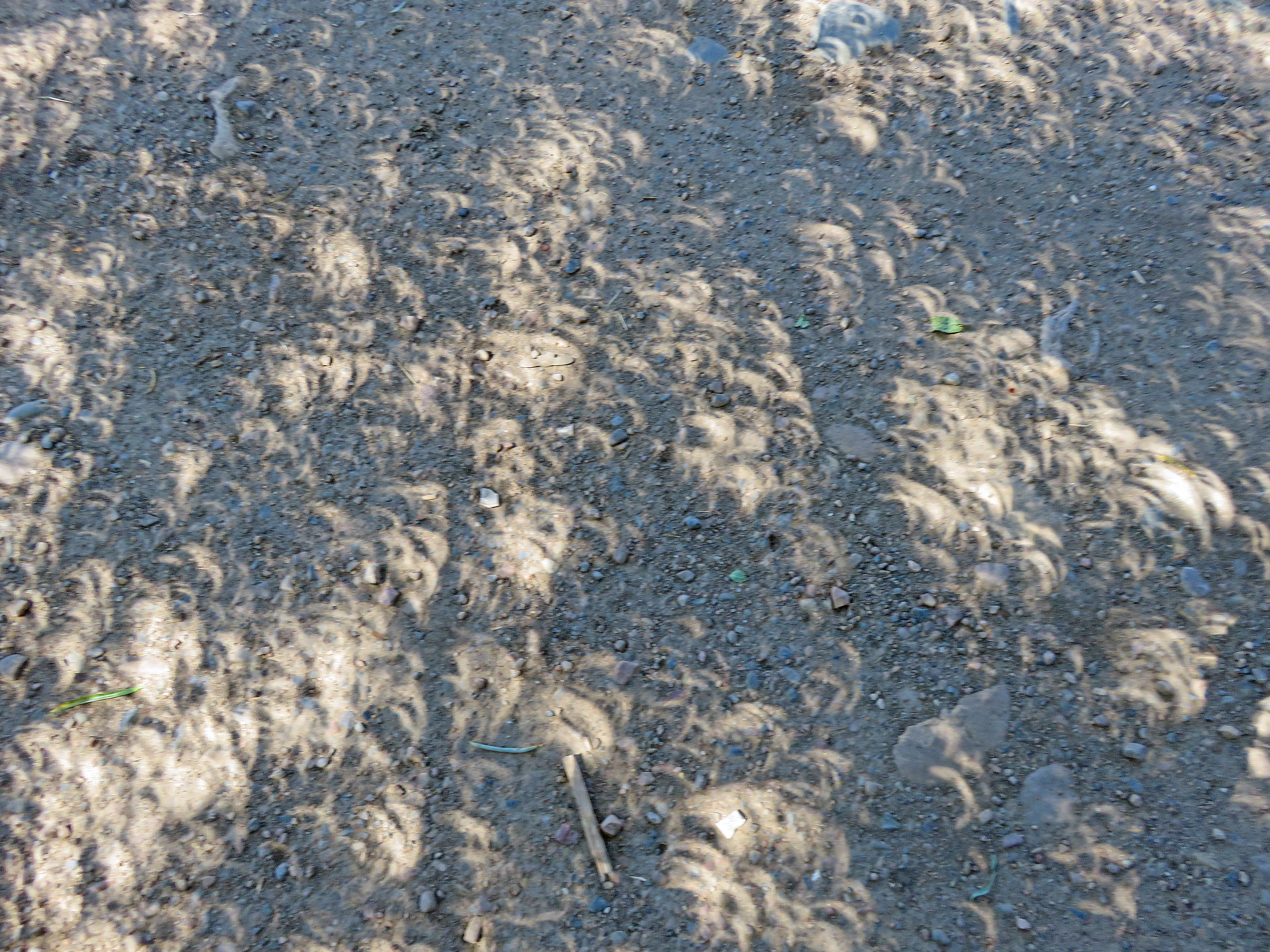
Leaf stipled shadow

Ninety-eight percent,
turns out isn’t mostly dim,
but sorta smoky

Like those brush fire days
when blazes light up the range
and wind blows our way,

Dimming the mountains.
I expected more twilight–
maybe a few stars.

Still—through the glasses,
the moon slid over the sun,
leaving a crescent.

It grew chill, and still,
and leaf shadows lay stipled.
Not Totality.


Squaw Mountain at 11:03 a.m.

Squaw Mountain at 11:21 a.m.

11:38 a.m. “Totality”

Siobhan and lamb, ready for the eclipse!


Tags: , , , , , ,

Ace Number One Cowboy

Casey and the docking team–Seamus, Siobhan and McCoy

While Casey posts photos on Facebook of his cowboy exploits with the rough and tough Ladder Ranch crew, here is what he is really up to!


Tags: , , , , , ,

Pat and Siobhan looking for cows

Pat and Siobhan near Sheep Mountain

 
Leave a comment

Posted by on June 7, 2017 in Animals, Cattle, Family, Folks, Horses


Tags: , , ,

Branding calves in the mountains and on the desert


It’s time to brand those calves which have been born this spring. We’ve been branding calves both in the mountains and the desert. We have our good crew of employees, friends and family on hand to help us with this endeavor.

Ready to gather: Cookie, Mike, Eamon and Karen

Siobhan and Dice

Taylor bringing in the cows

Mike and Tiarnan conferring

McCoy on the job


Pat and Cookie have a lot of irons in the fire!

Calves in waiting

Looking for the branding crew

Rhen and McCoy at work

David and Joe


Tags: , , , , , , , , , , , , , ,

Shearing 2017

In the shearing shed

It is hard to describe shearing season. It is essential, and ridden with uncertainty. The sheep must be shorn once a year in order to remain healthy and productive. The wool is a critical part of our income. And it is overwhelmingly important that the wool be shorn before lambing commences—a point that was brought home in 2015 when the scheduled shearers did not show up, and the problems of the season were exacerbated by weather and visa issues for the crews. We had to lamb in the wool, and organize a complicated shearing/docking operation in June.

Shearing of the range sheep herds is accomplished by contractors, who hire highly skilled crews (mostly foreigners, who need H2-A visas). It is a well-paid profession, but like most essential agriculture jobs, hardly filled by Americans. The contractors spend most of the non-shearing season vetting, hiring and completing paperwork so that they will have enough skilled, hard-working shearers to fill their crew.

Ewes coming in to the corrals

The contractors seek to work for producers with a large number of sheep. This means that they don’t have to move as often, and are guaranteed a good period of work. Producers develop reputations for their facilities and respect for the crew, as well as proximity to amenities such as grocery stores and fuel.

Likewise, shearing contractors are known for their speed, care of the sheep and the wool, and above all, reliability. Producers value the good crews and strive to hire them. It is a dance every year, with the crews shifting as the situations change. Loyalty goes a long way for both partners.

bringing in the ewes

This year our good California crew returned, and sheared our sheep in good order. We had luck that they were able to show up only a couple of days after our original target date. Sometimes the delay is many days, or weeks. Producers have to “stage” the sheep, since the shearing areas are usually at a fixed site, with usually “just enough” feed to support the sheep as they cycle through the shed.

Luka and Riley helping in the chute

In the old days, producers had large fixed sheds, which were designed to facilitate the movement of sheep and efficiency for the shearer. Most of these old Australian-style sheds are gone now, and the traveling crews have portable sheds which are basically small buildings on a trailer base. These are ingeniously designed to allow the sheep to enter a long chute from which the shearers (usually six or eight to a shed) can pull them to the shearing floor. After she is shorn, the ewe goes out a trap door to the left, while the wool slides out to the right. The wool handlers are waiting to sort and bale the wool just outside. Some crews have “sorting tables” to make it easier to skirt and bale the wool.

wool packing crew hard at work

About 40 fleeces go into each bale, tamped down by a large ramrod into a rectangular wool bag. Bellies and tags (dirty short pieces) are baled separately, as are different types and grades of wool. The wool handlers, often women, are also skilled and must work fast to keep up with the shearers, who outnumber them.

Kimmy, Uribe, Luis and David on the job

The weather is a huge factor in all this. Wet sheep cannot be shorn. The wool quality is ruined if it is baled wet. Shearers won’t shear wet sheep because it can lead to “wool pneumonia”. Cold spring storms are a threat to recently shorn sheep. In a week or so, enough wool grows back to allow the sheep to have some insulation, but freshly shorn sheep are very vulnerable to cold, wet weather. A late April storm in 1984 killed a quarter million ewes in Wyoming, Montana and the Dakotas. Some of them were ours.

All that said, we are grateful that we got through the week it takes us to shear with relatively good conditions, a good crew and healthy sheep. We have to trail to the lambing grounds now with the main bunches. The two-year-olds are already under way lambing at our lambing sheds, so all hands are busy.

Ciro and Pepe

shearing the black ewes

Uribe and Megan unbelling the black ewe

Rhen helping in the chute

Rhen and Cora pushing the ewes up

Rhen practicing mutton-busting with Uribe

Edgar pushing ewes along the chute in the shed

Maeve and Seamus playing “Throw Dirt at the Sibling While Guessing the Wind Direction”

Guard dogs with shorn ewes

McCoy, Eamon, Gramps and Pat

Meghan and Eamon conferring

Riley’s lunch for corral crew and shearing crew–a welcome sight!

Siobhan and Luka in the shed

Karen with Cora and Sam–“Come early,” I said. “It’ll be fun!” I said…and it was.

Pat contemplating the shorn ewes


Tags: , , , , , , , , , , , , , , , , , ,